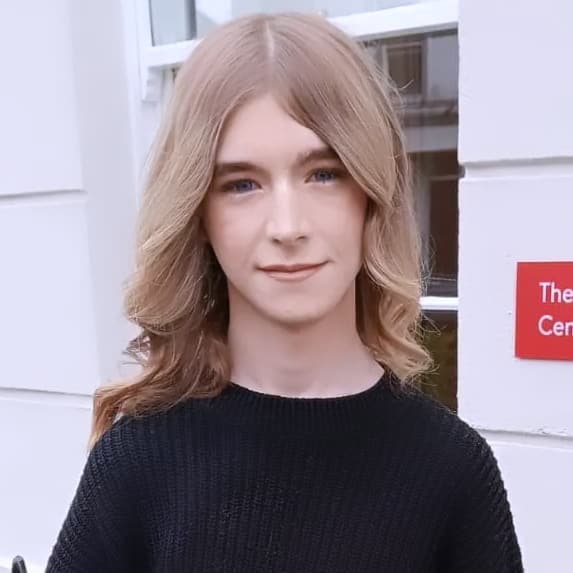
As part of GCN and Belong To’s ongoing collaboration to platform a whole new generation of LGBTQ+ voices, Ciara Kelly shares a powerful reflection on her experience as a trans woman and how she challenges rigid narratives.
New voices: Words of affirmation
How to describe gender dysphoria?
I could give the medical definition. The NHS states that it is “a sense of unease that a person may have because of a mismatch between their biological sex and their gender identity”.
I could also give melodramatic metaphors, “It feels like being trapped in the wrong body, like I just want to crawl out of my own skin”.
Still, it doesn’t quite capture the nuances of the lived experience. Medical institutions and the media often perpetuate a certain narrative of what dysphoria looks like: the image of a trans person who loathes every aspect of their body and is in a constant state of suffering.
Early in my transition, I doubted if my dysphoria was valid because of stories I had seen online. The reality is that dysphoria can look differently for every trans or non-binary person who experiences it. Whether you fit into a rigid narrative does not determine your validity. Sometimes, dysphoria manifests in ways that are not always obvious, loud, or easy to articulate.
In everyday life, dysphoria is more often fluctuating than constantly unbearable for me.
For instance, I struggle with dysphoria around my voice being ‘too deep or masculine’. Most of the time my voice does not bother me, while on other days or in certain contexts, I would rather not talk. I become self-conscious about managing the sound of it.
I remember I was making videos for Belong To’s social media campaign, ‘12 Days of Self Care’, and I took so many takes because every time I listened to myself, dysphoria would be hypercritical about my vocal pitch and how it would impact people’s perception of me.
Along with that, sometimes when I am around cisgender women it can be difficult not to compare my voice to theirs. In those moments I try to remind myself that women’s voices come in a wide range, and I shouldn’t hold myself up to an idealistic expectation of femininity. Voice training seems like an obvious solution, and while I have considered it numerous times, the thought of the long, exhausting process of ‘correcting’ my voice honestly makes me procrastinate.
Embracing the authenticity of my voice has been a part of the journey of accepting myself as I am, despite dysphoria.
Misgendering is another big trigger of my dysphoria, and even though I have loved ones who support and respect my identity, I deal with it from strangers every now and then, whether it be accidental or intentional. Accidental misgendering has looked like being referred to as ‘he’ in a new group setting, to which I quickly correct them and move on.
Intentional misgendering has looked like minding my own business on a walk, listening to music, when someone (usually a gang of lads) shouts a transphobic remark at me like “That’s a man!” or laughs and asks sarcastically, “Is that a male or a female?”.
Keeping my head down feels like the only option there. In both cases, I try my best to take the dysphoria in stride and go about my day. I know who I am after all.
However, sometimes the moment lingers and replays in my head, gradually wearing me down until dysphoria becomes overwhelming.
I have been on hormone replacement therapy for two and a half years at this point. I can say that it has greatly alleviated the severity of my dysphoria in general, while at the same time not being a miracle cure that has made it disappear.
I’ve heard stories of both extremes, HRT being an absolute lifesaver and HRT being a regrettable disappointment. Although I haven’t woken up overnight to find my body radically different, over time I’ve started to notice small changes that make me smile.
Patience has definitely been a virtue for me when it comes to the process. Going back to voice dysphoria, unfortunately oestrogen does not alter your voice like testosterone does, which shows the limits of HRT as a total cure for dysphoria.
While dysphoria persists, there are some practical strategies I use to help manage it when it spikes.
I write down gender affirmations, which can look like “I am beautiful”, “my dysphoria does not define me” or “I am woman enough”. This helps me break down the distorted narratives that my dysphoria tells me.
Secondly, I talk to someone, usually my boyfriend since he is also trans and understands dysphoria’s nuances on a deep level, even if we experience it differently.
Thirdly, I do something that brings me gender euphoria, like how I have made it a routine to get my nails and eyebrows done.
It can be the little ways of expressing my gender that bring me a lot of joy and calm my dysphoria in the moment. In my experience, finding what most helps alleviate dysphoria has been part of the transition process.
This story originally appeared on GCN.ie. For more New Voices and LGBTQ+ news, visit GCN.ie.
More News
Statement from Belong To in response to Prime Time
For over 20 years, Belong To – LGBTQ+ Youth Ireland has supported trans young people and their families Central to our work is ...
Read moreCelebrity hairdresser Andrew Fitzsimons talks about the importance of LGBTQ+ allies during Stand Up Awareness Week.
Stand Up Awareness Week, Ireland’s largest LGBTQ+ anti-bullying campaign, takes place from November 6-10, 2023 Celebrity hairdresser ...
Read moreWhy we decided to leave Twitter/X
Our vision is a society where LGBTQ+ young people are equal, safe and thriving This includes both offline and online spaces At Belong ...
Read moreIrish LGBTQI+ organisations to hold solidarity demonstration in Dublin as part of International Day of Action for LGBTQI+ rights in Turkey
Irish LGBTQI+ organisations, allies and supporters will gather in Dublin on Wednesday 30 September 2026 as part of an International Day of ...
Read moreArtist Spotlight: Changeling Craftworks, Bisexual Visibility Day 2026
What does Bi Visibility Day mean to you Bisexual Visibility Day is important to me because it shines a light on an often forgotten ...
Read moreReturn with Pride This Summer
Are you looking for a simple way to support Belong To and LGBTQ+ young people this summer SuperValu has ...
Read more